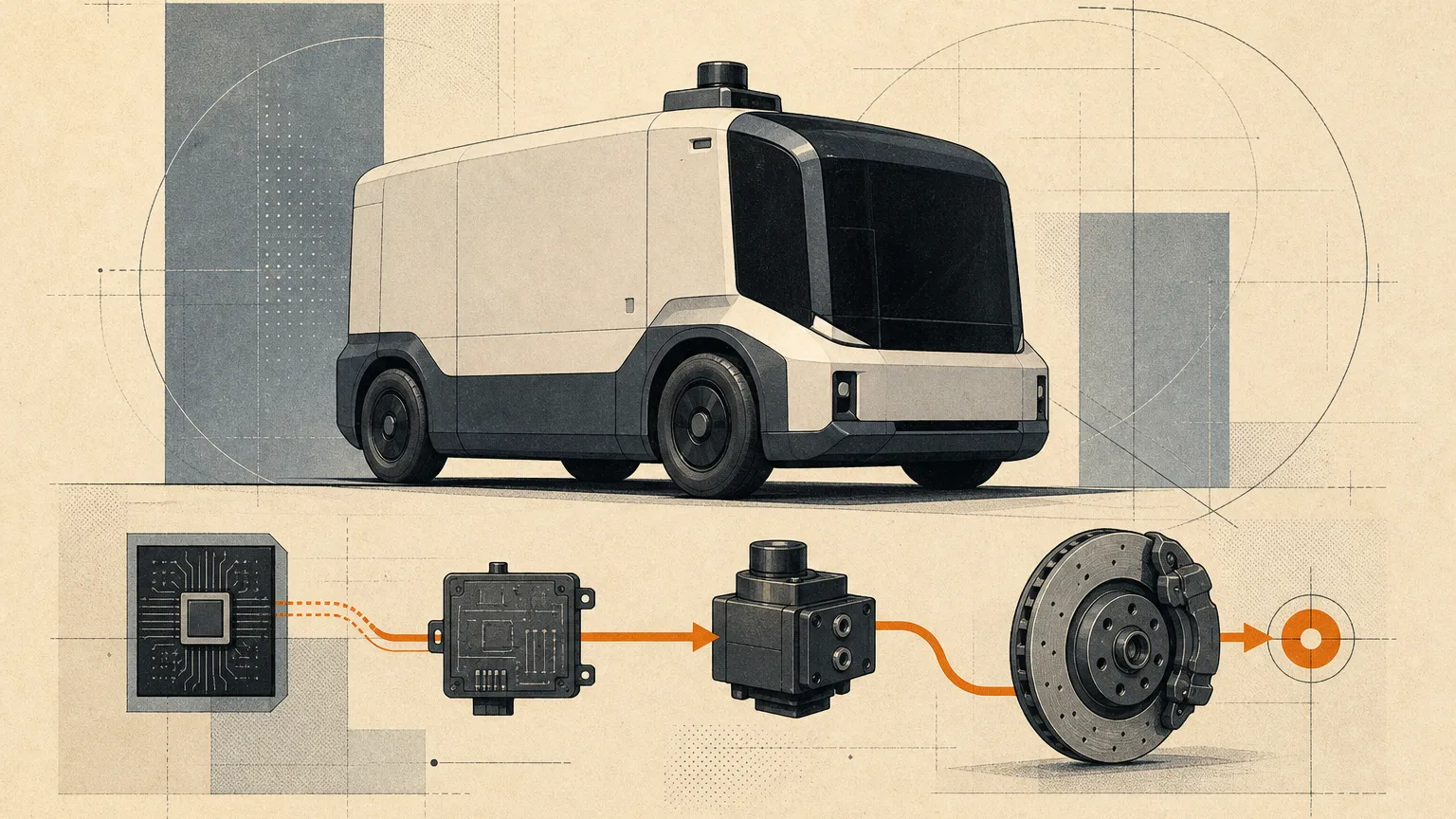
NHTSA has extended public comment on a proposal that would change how federal brake rules apply to automated vehicles designed without occupant-operated steering, accelerator, brake, or other manual driving controls.
The July 28 extension notice moves the deadline from July 27 to August 26, 2026. It does not finalize the proposal, establish an operative date for the proposed requirements, or change the rules that vehicles must meet today.
That distinction matters. Calling this a brake-pedal rollback would miss the core of the June 26 proposal: NHTSA wants to remove manual-control requirements from vehicles that are never meant to be human-driven while preserving the existing stopping-distance requirements.
The short version
Federal Motor Vehicle Safety Standard No. 135 was written around vehicles with human drivers. It assumes, among other things, that the service brake is activated with a foot control.
For an automated vehicle with no manual driving controls, that assumption creates a certification problem. The automated driving system can command the brakes electronically, but the rule still describes a pedal and the force applied to it.
NHTSA proposes to make those manual-control provisions conditional. A vehicle designed without manually operated driving controls would have to use onboard systems to activate the service and parking brakes. A vehicle that retains manual driving controls would still have to meet the existing manual-control requirements.
The proposal would not make a brake pedal optional on any vehicle that retains manually operated driving controls, and it would not require any manufacturer to remove one.
Scope and limits
What the proposal changes—and what it does not
| Area | Proposed treatment | Retained or separate boundary |
|---|---|---|
| Manual controls | Vehicles designed without human driving controls could omit human pedal and hand brake interfaces. | Vehicles that retain manual driving controls would retain the existing control requirements. |
| Brake activation and performance | Onboard systems would have to activate the service and parking brakes. | Existing stopping-distance limits and core brake-performance requirements would remain. |
| Compliance test | Timing would begin with the electronic command, using manufacturer-specified input where applicable. | The proposal does not establish one standardized electronic command-input method. |
| ADS behavior | This proposal does not define when an automated driving system should brake in traffic. | Decision-level performance is a separate standards question, and existing defect authority remains. |
What would actually change
The brake control would not have to be a pedal
In a vehicle with manual driving controls, the service-brake control would remain a foot-operated pedal. In a vehicle without those controls, NHTSA proposes defining the service-brake control as the component that turns an electronic braking command into mechanical input to the brake system.
That could be an actuator or another component in a brake-by-wire architecture. The proposal leaves open whether the final definition should cover one component or a broader subsystem.
The service and parking brakes would also need to be activated by onboard systems. An outside-only command channel would not satisfy the proposed requirement.
The stopping-distance clock would start with the electronic command
The current standard measures stopping distance from the initial application of force to the brake control until the vehicle stops.
For a vehicle with no service-brake pedal, the proposed measurement would begin when the electronic command is first transmitted to the service-brake control. NHTSA presents the two measurements as functionally equivalent tests of the brakes’ physical capability.
The test input could follow manufacturer specifications
Pedal-force limits make sense when a person has to operate the brakes. They do not map cleanly to an electronic command.
For vehicles without manual controls, the proposal would use manufacturer specifications for the brake-control input during testing. NHTSA says it would request manufacturer data and a demonstration of vehicle braking performance if it cannot independently test a vehicle, and that a standardized command-input method may be developed as these designs become more common.
A material open compliance-testing issue is that the stopping limits stay objective while the interface used to trigger the test is not yet standardized across vehicles.
What would stay the same
The official proposal PDF preserves the existing FMVSS No. 135 stopping-distance requirements. Covered vehicles would still need service brakes acting on all wheels, independently controlled service and parking brakes, and a parking brake capable of holding the vehicle under the standard’s test conditions.
ADS-equipped vehicles that retain manual driving controls would retain the existing requirements tied to those controls. NHTSA also says the proposal would not change the stopping-distance limits specifically for automated vehicles.
Separately, NHTSA proposes removing the requirement that the parking brake be a friction-type system. It would retain the requirement for solely mechanical means to hold the brake engaged and the existing test requiring the vehicle to remain stationary for five minutes in both directions on a 20 percent grade.
The document includes broader cleanup—such as removing obsolete non-ABS test provisions and correcting terminology—but those edits do not turn the proposal into an automated-driving performance standard.
The three layers that should not be confused
A useful way to read the proposal is to separate the braking sequence into three layers:
- Decision: The automated driving system decides that braking is needed and how much braking to request.
- Command: The system transmits an electronic instruction to the service-brake control.
- Physical response: The actuator and brake system decelerate and stop the vehicle.
This proposal mainly addresses the command-to-physical-response handoff. It says how stopping distance could be measured once the electronic command is sent and keeps the existing stopping-distance limits.
It does not establish whether the automated driving system recognized a hazard soon enough, chose the right braking level, or responded correctly to a passenger asking to stop. NHTSA says automated-driving performance in real traffic is a separate standards effort, while its existing defect authority remains available for unsafe systems.
Why the extension matters
The original Federal Register record still shows the old July 27 comment date, while the later extension controls and sets August 26. Systems that ingest only the original record can therefore surface a superseded deadline.
The extension also gives manufacturers, safety advocates, technical specialists, and the public more time to address unresolved questions: whether NHTSA should standardize the command input used for compliance testing, how passengers receive brake-failure warnings, and what consequences follow from removing manual controls.
How it developed
Proposal and comment-period sequence
Proposal published
The notice opened the rulemaking for comment; it did not create a final requirement.
Extension published
The later notice superseded the July 27 deadline and moved comments to August 26.
Docket still pending
No final rule, withdrawal, or supplemental proposal was present in the reviewed docket.
Comments due
This is the controlling public-comment deadline in the extension notice.
Next agency action
No final operative effective date exists in the proposal record reviewed for this article.
What to watch next
As of July 29, the live docket lists this as a pending proposal under docket NHTSA-2026-0728 and RIN 2127-AN00. The next meaningful signals will be new docket material, any supplemental proposal, a withdrawal, or a final rule that states the adopted text and effective date.
Until then, the accurate takeaway is narrow: NHTSA is proposing a different way to define and test brake activation for vehicles with no human driving controls. It is not proposing to remove the stopping-distance requirements, and it has not made the change final.